Turning loss into purpose: Air Force Veteran inspires others to try adaptive sports
When Cedric Anderson returned home from Iraq in 2009, no one could have predicted the battle that awaited him back home. What began as unexplained skin irritations – initially diagnosed as eczema – eventually turned out to be a rare immunodeficiency disorder linked to exposure to toxic substances during his service. For years, the Air Force veteran from St. Louisa, Illinois, quietly battled a condition that was slowly attacking his body from the inside out.
By January 2021, that battle had reached a crisis point. What started as a routine hospital visit for an IV ended in cardiac arrest, seizures, kidney failure and a ventilator. Anderson contracted COVID-19 while his immune system was already pushed to the limit. Prolonged intubation damaged his vocal cords, requiring surgery months later. He ended up losing both legs. Only recently has he begun to learn how to move forward and build a new life.
“It is what it is,” Anderson said. “I had to learn how to make good use of what I had.”
Through every hospitalization, failure and uncertain moment, his wife, Pamela Anderson, stood by him. Married for nearly 40 years, she is not only his life partner, but also his primary caregiver—monitoring symptoms, coordinating care, and fiercely advocating on his behalf. Over time, she learned to recognize the subtle physical signs—like changes in his skin, the sound of his breathing—that signaled his body was struggling.
“You have to learn to live life,” Pamela said, “because anything can happen.”
What neither of them expected was that the amputation would open doors rather than close them.
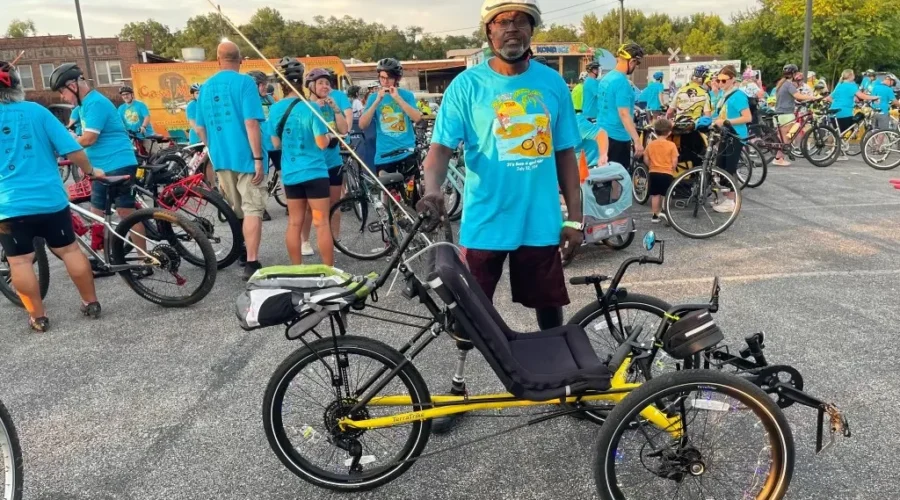
Recreational therapists in John Cochran VA Medical Center in St. Louisu introduced Anderson to adaptive sports and never looked back. Since then he has kayaked, rock climbed, surfed, skied, sailed and competed in soccer. He is now attending Golden Age National Veterans Games for the third time and participation in programs including National clinic for disabled winter sports and other non-profit local adaptive sports programs that support health, healing and community causes. Diving is next on his list.
“The blessing of amputation has pushed me in directions I didn’t know existed,” Anderson said. “People would look at me and feel sorry for me, but it opened doors that I would never have walked through otherwise.”
Outside of competition, Anderson became an informal mentor. He encourages fellow veterans at his local YMCA, visits newly amputated veterans at his church, and offers a perspective that only someone who has lived through it can provide.
His message to any veteran on the fence about adaptive sports is simple and direct: “Come watch me. And if I can do it, we can do it together.”
For Cedric Anderson, the mission never ended, it just changed the terrain. And as long as he’s moving, he intends to keep going.