92-year-old Veteran shares secret to long life at the Golden Age Games
At 92 years old, Air Force veteran Curtis Parker still enters each competition venue with the same goal he’s embraced for decades: enjoy the moment, do your best and leave with a smile.
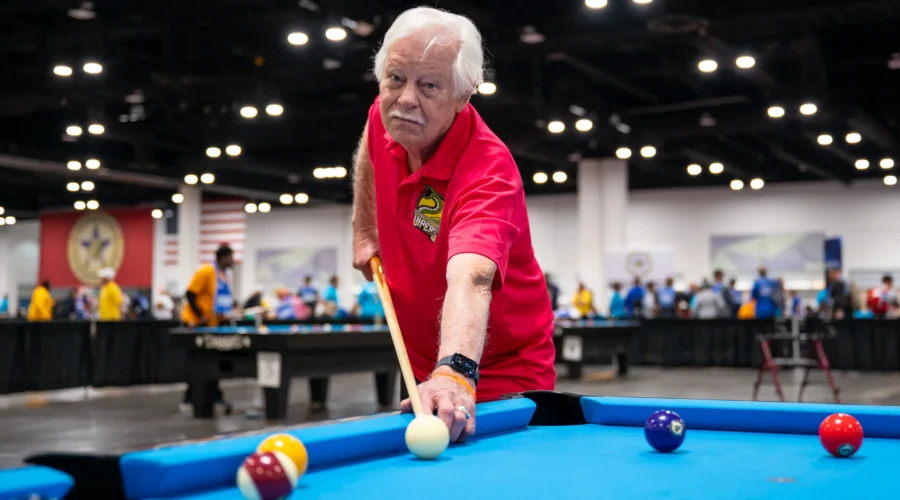
That approach paid off at 2026 Golden Age of Veterans National Games in Tampa, Florida, where Parker won the pool gold medal after an unexpected upset in the championship match.
“The other guy scratched an eight,” Parker recalled with a smile. “That put me first.”
A gold medal is nice, but it’s hardly the reason Parker keeps coming back to the Games. For him, the medals are just a small part of a week built on friendships, shared experiences and proof that age does not dictate what is possible.
“I love these guys,” he told George E. Whalen VA Medical Center recreational therapy veteran team in Salt Lake City. “I go shooting and golf with them. I’ve done cornholes and whatever. It’s inspiring just to watch them play sports.”
From service to staying active
Parker served in the Air Force from 1952 to 1954 during the Korean War era. More than seven decades later, at home in South Jordan, Utah, he works out on the family pool table and wears weights to keep in shape.
“It’s a lot of work trying to keep my strength up,” he said.
Golf presented a different challenge in Tampa. The oppressive heat and humidity made for a tough round, but Parker still fought back to finish second in his division.
“It was hot,” Parker said. “It was hard to play my normal game.” Still, he dismissed his score in the same way he learned to deal with all of life’s setbacks.
“Some days are good,” he said. “Some days are not so good.”
His wife, Sylvia, 86, watched that look guide her husband through the years of competition. She believes the Games give him a reason to stay active long after many people his age would have slowed down.
“I think it inspired him to stay in shape,” she said. “He’s walking around holding five-pound weights in his hands at home because he’s going to compete in the air pistol. That gun gets heavy after a while.”
The games also became significant for Silvia, who found her own way to contribute. Last year, she volunteered to guide a visually impaired golfer, helping him set up shots, describing distances and providing encouragement throughout the course. This year, she teamed up with the same veteran again.
“He said, ‘I’m so glad to see you again,'” Sylvia said. “It feels good to help someone.”
Life beyond the Games
At home, the Parkers stay busy at their senior community, where Sylvia has started a dance class and mahjong group, while Curtis continues to practice for competitions.
But perhaps Parker’s greatest achievement can’t be measured in medals.
Through adaptive sports, he has built friendships that extend far beyond the playing field. He regularly visits a fellow veteran on dialysis, whom he affectionately calls his adopted son after a younger man started calling him “pop.” He also befriended another veteran who uses a wheelchair, visiting him after the loss of his emotional support dog and encouraging him to get out of the house for dinner and conversation.
Earlier this year, Parker also traveled on an honor flight to Washington, DC, where he joined fellow Korean War veterans in receiving the Korean Defense Medal from representatives of the Republic of Korea. It was another reminder that the bonds formed through military service often last long after the uniform is put away.
As one of the oldest competitors at this year’s Games, Parker enjoys surprising people who ask him where he grew up.
“I tell them I didn’t grow up,” he said with a laugh. “I’m trying to show that at 92 you can still have fun.”
As long as he can pick up a pool cue, swing a golf club or lift an air pistol, Parker plans to keep competing.
“You bet,” he said when asked about a return to the Games next year. “I want to continue as long as I can.”